

LIMBS! Not the Victorian kind that was never allowed to be shown. Seriously, until the internet, those Brits had the MOST pornography ever!
We have a young forest covering the hillside. It’s mostly Douglas Fir and Alder. Those trees put out a lot of the aforementioned limbs. It’s pretty typical for our part of the PNW and also for our biome to just be covered in these trees. We live on a hillside. We have a sandy creek at the bottom and we’re solid clay loam nearly everywhere else. Thanks glacial till!
While the soil dictates what likes to grow here naturally, we have to work with those plants to make the environment work for us. Our forest was replanted in the early 2000s. That means we’re in its growing pains stage of life. Our awkward little teenager needs to be told he’s pretty and that he’s the strongest boy in his class. He also needs a little help looking a little less scruffy in the worst possible way.
Practical Translation: We’re at the point where animals should be moving through the understory and knocking down limbs and other loose brush and that should be turned into food and ideal soil conditions for the next generations of plants.
Guess who those animals are…it us!
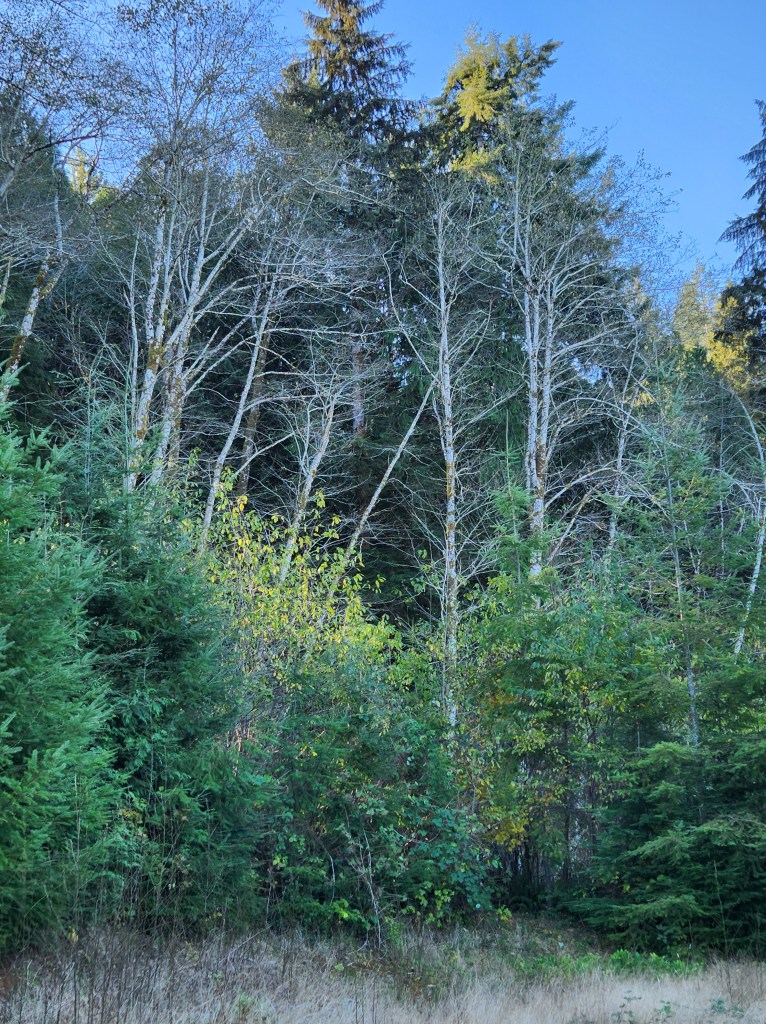
So why have I did I intro this talking of limbs? Because, that’s what we’ve been doing the last few weeks. While the house is being built and we’re commuting out to do work, we’re trying to be intentional with what we can accomplish while still having the energy to drive back to the city. So right now we’ve been spending our time trimming low limbs from douglas fir and cutting them into chunks that the forest can eventually consume.
We’re also hand breaking dried up brambles and elderberry canes that are being outcompeted now that our forest canopy is starting to mature. So why do this at all, you might ask? Shouldn’t nature do this for you? Sure. But Mother Nature takes her time and we’re not in a waiting mood.
So why do this at all? Well, it reduces our fire load. Wild fires are a concern in the Western US. And the advice we’ve been given is to get as much of this low growth that’s dry and non functional. (We’re only take non-leaf bearing parts of trees and shrubs.) and get those down to reduce the total amount of flammable material that could catch if a fire were to cross our creek. Ideally, we’d spend all winter doing this. (Yes, the PNW is workable in winter, but we didn’t this year.)
So we live under the canopy right now, which honestly is pretty great and it means we’re learning a lot about our land. We’re finding culverts just off our road. We found a little hill seep the other week. So really this has been a great side benefit for our knowledge about the overall microclimes and biomes that exist on the hill.
This won’t be the case for everyone, but doing work on your land really does help you to get to know it better. My guess is that over the coming weeks (if the heatwave doesn’t kill us), we’re going to start to learn a lot more about what our land does really well.
I’d advise anyone looking to start a project like ours to consider the following:
- Consider how you’re going to do work while waiting for your home to exist.
- Consider the work you can do to get ready for life out on the land. What’s feasible. What’s not? It doesn’t have to be hardcore. We spend 4 hours of a morning doing this and then go grab lunch on the way home. It’s a nice workout and we get to see what’s been living in our undergrowth.
- Uncover the unexpected. There are going to be unknowns. We’re finding our road’s drainage paths which has been super helpful and will continue to be as we maintain that road into the future.
- Learn about the plants that are already on your property. They’re going to tell you what the sun and land want to do naturally.We discovered this last year, but I’m really starting to see what’s done well for 15 years will likely be outcompeted in the next five.
- (i. e. elderberry and blackberry) These starting to struggle, but the lowlighters that can live in almost full shade (red huckleberry, thimbleberry and salmon berry) seem to be holding there own…for now.
 Olympic Homestead
Leave a comment